A Comprehensive Analysis of Perfume Testing
A Comprehensive Analysis of Perfume Testing: From Olfactory Theory to Industrial Regulation
Part 1: The Theoretical Framework of Scent Evaluation
Section 1.1: Deconstructing the Olfactory Pyramid: Architecture vs. Schedule
The foundational model for understanding and describing a perfume's structure is the olfactory pyramid. This concept divides a fragrance's composition into three distinct phases that are perceived to reveal themselves sequentially over time: the head (or top) notes, the heart (or middle) notes, and the base notes.
- Top Notes, also known as head notes, constitute the first impression. They are composed of the smallest, lightest molecules in the formula, making them highly volatile. These notes are designed to be bright and assertive, catching the consumer's attention. However, they evaporate quickly, typically fading within a 5 to 30-minute window. Common examples include citrus (like bergamot and lemon), light fruits, and sharp herbs (like mint or basil).
- Heart Notes, also called middle notes, emerge as the top notes dissipate. This layer is considered the "core personality" or "main character" of the fragrance, forming the "liaison" between the fleeting top and the deep base. These notes often comprise 40-80% of the final fragrance formula and are much less volatile than the top notes, typically lasting for two to four hours. Florals (such as rose and jasmine), green notes, and spices (like cinnamon) are common components of the heart.
- Base Notes form the "foundation" or "soul" of the perfume. Composed of the heaviest, richest molecules, they are the least volatile and serve as fixatives, providing depth, warmth, and longevity to the entire composition. These notes are what linger on the skin for hours, often from six hours to a full day. Common examples include woods (sandalwood, cedarwood), resins (amber, frankincense), vanilla, and musk.
A critical, often misunderstood, aspect of this model is that the pyramid is not a literal schedule. It is a simplification of a complex chemical process. A more accurate analysis reveals that "notes don't come and go: they are all present together when you spray". Each ingredient, from top to base, begins to evaporate immediately, but at its own specific pace according to its "vapor pressure".
This reframes the pyramid as a metaphor for architecture and perceived volatility rather than a sequential activation. The wearer may detect rich base notes like oud "with the first spritz". The "unfolding" of the scent is not the arrival of new notes, but the gradual unmasking of the less volatile heart and base notes as the highly volatile top notes dissipate. This common misunderstanding is why some consumers question the reality of the pyramid structure, as they are expecting a dramatic, three-act play rather than a slow, blended evolution. This distinction is paramount for a tester, who must learn to observe this gradual, layered evaporation rather than simply waiting for a "new" scent to appear.
Table 1: The Olfactory Pyramid: Structure, Volatility, and Function
|
Note Type |
Molecular Characteristic |
Purpose in Composition |
Typical Evaporation/Perception Timeline |
Common Examples |
|
Top (Head) |
Light molecules, high volatility |
"First impression," creates initial intrigue and catches attention. |
0-30 minutes |
Citrus (Bergamot, Lemon), Mint, Aromatic Herbs |
|
Middle (Heart) |
Medium molecules, medium volatility |
Forms the "core character" or "main theme" of the fragrance. |
20 minutes – 4 hours |
Rose, Jasmine, Cinnamon, Geranium, Spices [1, 6, 7, 10] |
|
Base (Soul) |
Heavy molecules, low volatility |
Provides depth, warmth, and longevity; acts as a fixative for the lighter notes. |
1 hour – 24+ hours |
Sandalwood, Amber, Vanilla, Musk, Patchouli [3, 5, 6, 7] |
Section 1.2: The Critical Narrative: Understanding the Dry Down
The "dry down" is the final and most critical phase of a fragrance's life cycle. It represents the "true character" of the scent, what remains on the skin for hours after the more volatile top and heart notes have faded, revealing the full expression of the base notes. This is the "conclusion to the fragrance's story" and should be the ultimate point of evaluation for any prospective buyer.
The time it takes to reach this final phase varies significantly. Citrus fragrances may dry down in as little as 10-20 minutes, while complex woody or amber-heavy scents can take 60-90 minutes to fully reveal their base. Furthermore, concentration dictates the pace; a lighter Eau de Toilette (EDT) will dry down much faster than a more concentrated Eau de Parfum (EDP) or a dense Parfum (Extrait).
A common myth among inexperienced testers is that the "immediate smell is the final scent". This is fundamentally incorrect. The bright, appealing top notes are often compared to an advertisement for the fragrance, while the dry down is the actual product. This creates a significant "Top-Note-to-Dry-Down-Gap." Consumers may be captivated by an initial spray, only to find the dry down hours later to be disappointing, or conversely, be underwhelmed by a "meh" opening but find the dry down is "Heaven".
This very disconnect has reshaped the modern fragrance market. Industry-facing research has long recognized that simple "sniff-testing"—the act of making a decision in the first few seconds at a counter—is "unreliable" and potentially "misleading". That research concludes that perfume, more than almost any other consumer good, must be tested in "extended usage". The economic infrastructure of at-home sampling, discovery sets, and decanting services is a direct market-based solution to this "problem" of the dry down, allowing consumers the time and space to properly conduct the extended evaluation that is impossible in a traditional retail setting.
Part 2: The Consumer Protocol: A Strategic Guide to Personal Testing
Section 2.1: The First Encounter: Blotter vs. Skin
The practical application of perfume testing begins with a methodical approach. The first and most critical best practice is to "Start with a Clean Slate". The tester's skin should be free of any other scented products. Furthermore, as well-moisturized skin holds fragrance more effectively, applying an unscented lotion beforehand is recommended.
The debate between testing on paper blotters versus human skin is often framed as an "either/or" choice, but this is a false dichotomy. A strategic tester must use both, as they serve two distinct and sequential purposes: filtering and validation.
- Step 1: The Blotter (Filtering)
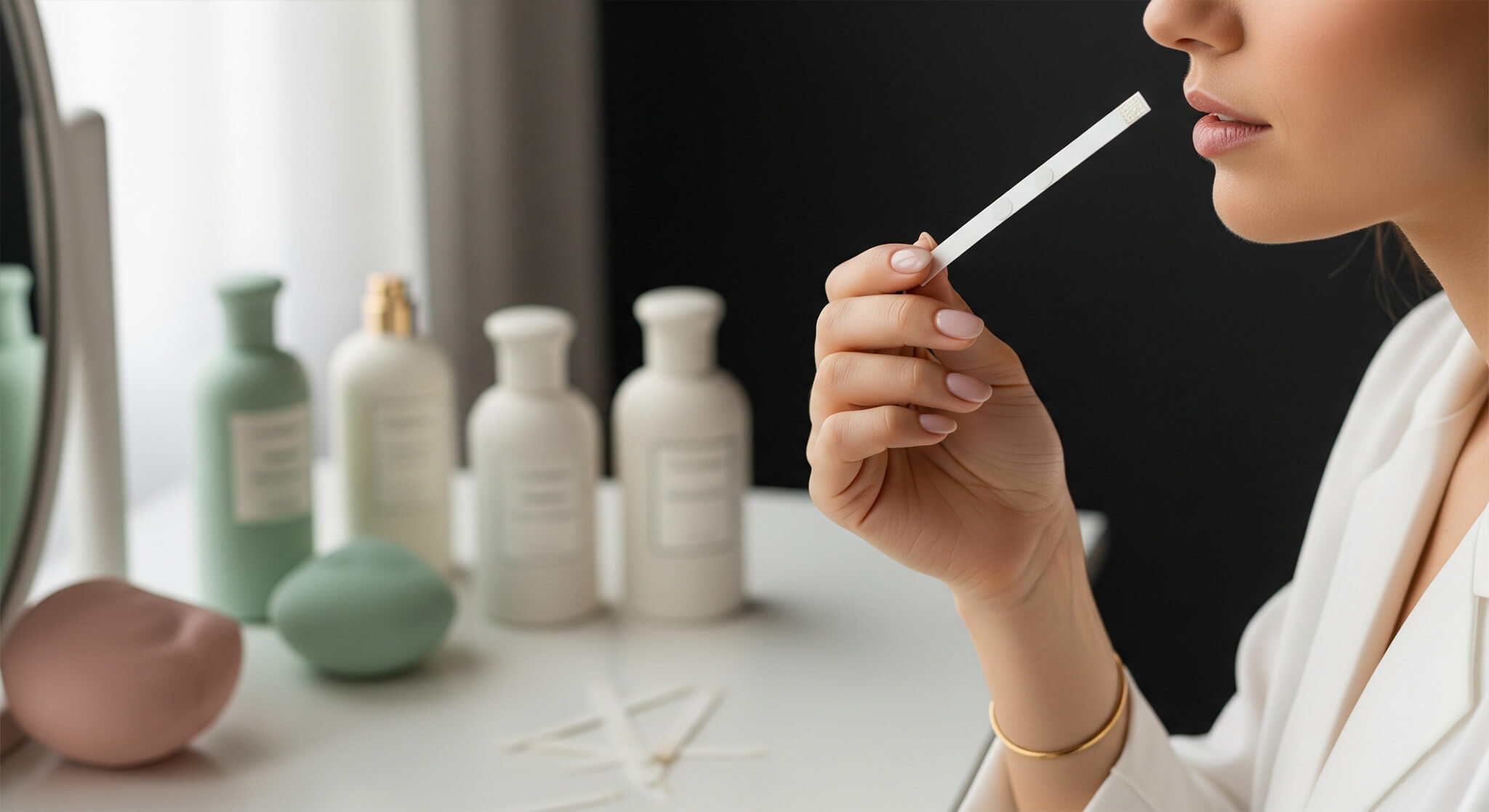
The first encounter with a new fragrance should always be on a paper blotter or test strip. This is the "objective way to smell" the fragrance as the perfumer designed it, without the interference and "bias" of one's personal skin chemistry. Blotters are made from absorbent, porous paper that allows the scent to be "read" clearly.
Technique: Use a fresh blotter for each fragrance. Spray the blotter from a distance of 3-5 inches (or 15cm). Wait a few seconds for the initial alcohol blast to evaporate before sniffing. Keep the strip an inch or two from the nose. Crucially, the tester should label each strip with the fragrance name and the time of application to track its evolution.
- Step 2: The Skin (Validation)
After using blotters to filter a wide selection down to a few top contenders (e.g., 1-3 fragrances), the next step is to test on skin. While the blotter reveals the composition's quality, the skin test reveals its compatibility. This is the subjective, personal experience that ultimately determines the purchase.
Technique: Apply the fragrance directly to pulse points, such as the wrist or inner elbow. "Air-walking" through a mist is an ineffective application method. Spray one or two spritzes and let the scent settle for at least 30 seconds. Most importantly, do not rub the wrists together. This common habit is destructive; the friction and heat "break down" the fragile top notes and "damages the composition," altering its intended development.
This two-step process is the most effective strategy. A consumer who skips the blotter step will quickly run out of "skin real estate" and suffer olfactory fatigue. A consumer who only tests on a blotter risks purchasing a scent that reacts poorly with their unique body chemistry.
Section 2.2: Managing Sensory Input: Olfactory Fatigue
A significant physiological barrier to effective perfume testing is "olfactory fatigue," also known as olfactory habituation. This is a real sensory adaptation where the brain becomes desensitized to a constant stimulus to prevent an overload of the nervous system.
For decades, the perfume industry's ubiquitous "solution" to this problem has been to provide small jars of coffee beans. The common belief is that sniffing the strong aroma of coffee "resets" or "cleanses" the olfactory palate.
This is, however, a pervasive myth. Scientific study has demonstrated that coffee beans do nothing to functionally cleanse the olfactory receptors. In fact, they may exacerbate the problem by introducing another strong, complex, and competing odor, confusing the nose further. The practice persists purely as a form of "service theater" or a "psychological" distraction. This ritual is so ingrained that it can lead to confusion; one anecdotal report from a high-end department store counter detailed an embarrassing incident where a shopper, new to the ritual, proceeded to eat the beans, much to the horror of the staff.
The actual techniques used by perfumers and scent experts to combat olfactory fatigue are far simpler and more effective:
- Sniff Your Own Skin: This is the most effective and professional method. By smelling a neutral, unscented part of your own body (such as the crook of the elbow), you provide your brain with its own "baseline" scent. Since your brain is already habituated to your personal smell, this acts as a true "reset".
- Take a Break: The simplest solution is to stop all sensory input. Step outside for fresh air, allowing your nasal receptors to recalibrate.
- Sniff Wool: A less common but effective trick is to sniff a piece of pure wool. It is theorized that the natural lanolin or filtering properties of the fibers help neutralize the olfactory sense.
The presence of coffee beans can thus serve as a litmus test for a store's expertise. A true niche expert is more likely to advise a customer to "smell your elbow", demonstrating a scientific understanding of olfaction.
Section 2.3: Multi-Scent Sampling Strategies
Testing multiple fragrances requires a disciplined, strategic approach.
- The In-Store "Sprint"
The goal of an in-store session is not to make a final decision, but to shortlist potential candidates. Given the high risk of olfactory fatigue, the key is limitation and efficiency.
- Limit Tests: Test no more than three to five fragrances in a single session.
- Use a System: First, test all candidates on blotters, writing the name on each. Once filtered, apply the top two, three, or at most four fragrances to different, non-touching areas of "skin real estate" (e.g., left wrist, right wrist, left inner elbow).
- Leave the Store: This is the most critical step. A scent-saturated department store is the worst possible environment to evaluate a fragrance's true character. The tester must leave the store to allow the fragrances to evolve on the skin and experience the full dry down over several hours.
- The At-Home "Campaign"
This is the "connoisseur" method and the only way to truly conduct the "extended usage" test. This method, which requires acquiring 1ml or 2ml samples, allows for a slow, deliberate, and scientific evaluation.
- Control the Environment: Test in a neutral space, free of competing smells.
- Keep a Scent Journal: Take detailed notes on paper or in a spreadsheet. Track the perceived evolution from top to middle to base, as well as objective measures like sillage (projection) and longevity.
- Test Over Time: A fragrance should be given "a day". Personal preferences and even skin chemistry can be affected by mood, hormones, or one's menstrual cycle.
- Comparative Testing: Test a fragrance "versus" others with similar note profiles (e.g., three different vanilla scents) to better understand its unique nuances.
This methodical at-home process represents a fundamental paradigm shift from "perfume shopping"—a single, flawed event—to "perfume curation," a long-term, personal journey of discovery.
Part 3: The Testing Infrastructure: Navigating the Modern Fragrance Market
Section 3.1: The Retail Landscape: A Case Study (Amsterdam)
The environment in which a perfume is tested is as critical as the method. The choice of retail venue pre-determines the type of strategy a consumer can employ. The Amsterdam fragrance market serves as a useful microcosm to analyze the two dominant retail models.
- Model 1: The Department Store (e.g., De Bijenkorf)
De Bijenkorf is described as the Netherlands' "largest premium department store" and a "true institution" located on Amsterdam's central Dam Square. For perfume testing, its primary advantage is volume. It is a "one-stop luxury shopping experience" where consumers can "sample all the perfume lines" from major designer and niche brands—such as Diptyque, Jo Malone, and Le Labo—all in one place.
This environment is ideal for a breadth-first testing strategy, allowing for side-by-side comparison. However, it is also a scent-saturated, overwhelming space that encourages the rapid, flawed "sniff-test" and often relies on "service theater" props like coffee beans.
- Model 2: The Niche Boutique (e.g., Perfume Lounge, Skins)
In contrast, Amsterdam is also home to specialist boutiques that cater to "niche fragrance lovers". These include stores like Perfume Lounge, Skins, Babassu Beauty, and Salle Privée.
These venues are not built for high-volume comparison but for curation and discovery. Their focus is on "iconic brands with a story" and brands that are "exclusively available" at their location. The primary value they offer is "passionate... personalized fragrance advice" from staff valued for their "vast knowledge" and "exceptional service". This environment is ideal for a depth-first strategy.
An expert tester understands how to leverage both models: visiting niche boutiques to discover new houses and acquire samples, then visiting the department store to compare those discoveries against mainstream offerings.
Section 3.2: The At-Home Testing Economy
The rise of the "at-home sampling economy" is the most significant modern development in fragrance testing. This infrastructure was created specifically to solve the fundamental flaws of the in-store model: the inability to escape olfactory fatigue and, most importantly, the impossibility of evaluating a perfume's full dry down.
Acquiring 1ml-2ml samples is now the "STRONGLY recommend[ed]" way to "try before you buy" and "test drive" a scent in a controlled environment over multiple days. This economy operates on three distinct models:
- Brand-Direct Discovery Sets: Brands themselves commonly sell curated sets of their own fragrances. This is a powerful, conversion-focused marketing tool. Brands like Commodity, for instance, include a discount code for the full price of the kit, redeemable against a full-size bottle, effectively making the sampling free for customers who convert.
- Curated & Subscription Services: These companies sell discovery itself as the product. They offer themed monthly subscription boxes (like Smell Stories or Olfactif) or personalized kits. This is an editorial model, guiding consumers to new and niche brands.
- Third-Party Decant Services: These are a la carte sampling services. Companies such as DecantX, Scent Split, MicroPerfumes, and Luckyscent purchase authentic, full-size bottles and "decant" them into smaller sample vials for individual sale. This is the "long-tail" model, allowing consumers to sample virtually any fragrance.
This "discovery economy" has fundamentally de-risked high-cost perfume purchases and shifted the balance of power. Brands can no longer rely on a 30-second, top-note-heavy "sniff-test" to make a sale. The consumer is now empowered to judge the entire fragrance story.
Part 4: The Industrial Protocol: Testing for Quality, Stability, and Safety
Section 4.1: Quality Control and Consistency
While consumers test for discovery, manufacturers test for consistency, safety, and quality. The goal of industrial Quality Control (QC) is to ensure every bottle is identical to the master formula and safe for use.
- The Machine (Objective Analysis)
The industry's "method of choice" is Gas Chromatography (GC), often paired with Mass Spectrometry (GC-MS). This technology acts as a "fingerprint" analysis. It allows QC technicians to:
- Authenticate Raw Materials
- Ensure Batch Consistency
- Detect Contaminants or "falsification" (counterfeiting)
While the GC confirms the chemical formula, it cannot confirm the final scent experience. Manufacturers rely on a trained panel of expert perfumers, or "noses," to conduct "sensory evaluations" and "detect minute differences" that a machine might miss.
This QC process also includes microbiological testing for safety and "packaging integrity" checks. This reliance on GC-MS technology, however, has a market implication: it is the same tool that allows a "dupe" or "clone" house to reverse-engineer a formula.
Section 4.2: Stability and Shelf-Life Testing
A fragrance must remain stable throughout its entire shelf-life. Manufacturers conduct rigorous "stability testing" to evaluate a perfume's resistance to environmental factors like light, heat, and air. This "predictive test" determines "product longevity" and establishes an expiration date.
This process involves "torture testing" the product under various accelerated conditions:
- Accelerated Stability (Heat): Storing samples in climate chambers at elevated temperatures (e.g., 35°C, 45°C, 50°C).
- Light Exposure Testing: Placing products in "UV light cabinets" to assess the impact of light, which can degrade volatile notes.
- Cycle Testing (Freeze-Thaw): Subjecting the product to repeated extreme temperature cycles to simulate shipping.
- Real-Time Stability: Storing a control batch under "normal conditions" for 1-3+ years to validate the accelerated data.
This industrial process provides a direct, scientifically-backed guide for consumers on proper perfume storage. The industry knows precisely what destroys a fragrance: high heat, direct light, and temperature/humidity fluctuations. Therefore, the optimal consumer storage strategy is a cool, dark, and temperature-stable environment, such as a closet or a drawer. The common practice of storing perfume in a warm, humid bathroom is one of the fastest ways to damage the composition.
Section 4.3: New Product Development: Consumer Panel Testing
Before a fragrance is manufactured, it must be tested for market viability. Historically, the industry has been criticized for a lack of "systematic consumer product-testing," often relying on the same flawed "sniff-testing" seen at retail counters. This is "unreliable" as it only gathers data on the top notes.
The major implication from this research is that perfume must be evaluated via "extended usage". This has led to the adoption of formal "in-home usage tests" (IHUT), where consumers are given a product to use in their real-world environment.
The "at-home sampling economy" has inadvertently become the world's largest, most effective public consumer panel. When a brand sells a "Discovery Set", the consumers who buy it are voluntarily conducting the exact "extended usage test" that brands previously had to pay for. By analyzing online reviews, social media posts, and repurchase rates from these sample sets, smart brands can gather faster, cheaper, and more authentic market validation than ever before.
Part 5: The Ethical and Regulatory Gauntlet: "Cruelty-Free" Testing
Section 5.1: The EU Cosmetics Regulation: A Landmark Ban
One of the most profound changes to perfume testing has been driven by ethical and regulatory forces. The European Union's landmark Cosmetics Regulation (EC) No 1223/2009 established a comprehensive ban on animal testing for all cosmetic products, including perfumes.
The regulation was implemented in two phases:
- A Testing Ban: Prohibited testing finished products (banned since 2004) and ingredients (banned since 2009) on animals.
- A Marketing Ban: Taking full effect in March 2013, this made it illegal to sell or market any cosmetic product within the EU if the product or its ingredients had been tested on animals, regardless of where in the world the testing took place.
This "marketing ban" was a masterstroke of regulatory "soft power." Because the EU is the world's largest market for cosmetics, this law forced global corporations to abandon animal testing for their entire supply chain if they wished to retain access to the lucrative European market.
Section 5.2: The REACH Paradox: A Legal and Ethical Conflict
Despite this, a contentious "grey area" persists due to a separate, superseding EU law: REACH (Registration, Evaluation, Authorisation and Restriction of Chemicals).
REACH governs all chemical substances, not just cosmetics, with the goal of protecting human health (primarily industrial workers) and the environment.
The conflict is this: while the Cosmetics Regulation bans animal testing for consumer safety, REACH may still require animal testing for an ingredient to assess risks (like long-term toxicity) for which no viable non-animal alternative yet exists. This testing is often justified to ensure worker or environmental safety.
A 2023 European General Court judgment (the Symrise AG case) clarified this. The Court ruled that the Cosmetics Regulation ban only covers animal tests performed specifically for the cosmetic safety report. It does not ban tests required by other regulations (i.E., REACH).
This creates a "catch-22" for the industry. A brand can be 100% compliant with the Cosmetics Regulation while its ingredient supplier is simultaneously being forced to test that same ingredient on animals to comply with REACH.
Section 5.3: Navigating Modern Market Claims (2024)
This complex landscape has created a confusing market. Consumers are driving demand for:
- Cruelty-Free: Not tested on animals.
- Vegan: Contains no animal-derived ingredients (like musk or honey).
- Clean: An unregulated term implying the product is free from "harmful chemicals" like parabens or sulfates.
A product can be "vegan" but still tested on animals, or "cruelty-free" but not "clean." The primary reason that an estimated 78% of the world's top 50 beauty brands are still not considered cruelty-free is not the REACH paradox, but a conscious financial decision to "fund animal testing" by selling their products in markets that require it by law (historically, this included mainland China).
This has transformed "testing" into a multi-faceted act. The consumer is not just testing the scent of a perfume; they are testing the ethics of the brand.
Part 6: Concluding Analysis and Expert Recommendations
The concept of "testing perfume" has evolved from a simple act of smelling into a complex, multi-faceted domain spanning sensory science, industrial chemistry, global economics, and regulatory law.
- For the Consumer: "Testing" has evolved from a flawed, 10-second "sniff-test" to a methodical, long-term experience. The new at-home testing economy has empowered consumers to evaluate a fragrance's true character—the dry down. Simultaneously, consumer "testing" has expanded to include an ethical audit of a brand's policies.
- For the Industry: "Testing" is a high-stakes, data-driven process of control. In manufacturing, it guarantees consistency (via GC-MS) and stability (via accelerated aging tests). In R&D, it has shifted from unreliable first impressions to a reliance on extended in-home usage data—data now provided organically by the sampling market itself.
- For the Regulator: "Testing" has become a complex legal battleground, with the EU's Cosmetics Regulation in direct conflict with its own REACH regulation.
Final Expert Recommendation
The future of the fragrance industry will be defined by those who master "testing" in all its forms.
- Brands must now compete on the entire lifecycle of their product, not just the fleeting top notes. Success requires creating fragrances that excel in "extended usage", embracing the at-homeness discovery economy as both a sales funnel and a vital data-collection tool.
- Consumers must permanently abandon the "sniff-test." The new infrastructure empowers a more intelligent, patient, and methodical at-home approach. A consumer must acquire samples, test on skin, keep notes, and live with a fragrance for days. They must understand that the real test of a perfume only begins after they have left the store.
References
- PubMed Central (National Institutes of Health):First impression versus extended usage: a comparison of product testing methodologies for perfume
- Perfumer & Flavorist:Olfactory fatigue: what it is and how to avoid it in product testing
- Sylvaia.com: An Expert Guide to Avoid Costly Mistakes